
List the commitments before you touch the tone
An email carries two kinds of sentence. One kind is social: the greeting, the thanks, the apology for the delay, the closing line. The other kind is operative: who will do what, by when, for how much, and under what condition. The first kind can be rewritten freely. The second kind is the message, and once it is listed you can see exactly what a rewrite is allowed to do.
Write the operative sentences out as a list before the rewrite starts. Four questions per line: who is named, what action is promised, what date or period applies, and what condition or exclusion limits it. An email that answers all four for every line is unusual, which is the point — the unanswered lines are where a rewrite does its damage.
Order matters less than completeness. A short message may have three operative sentences, a quotation may have twelve, and both lists are still short enough to read in a minute. Anything you cannot classify as social or operative is probably operative.
Separate tone from terms
The rewrite may change the salutation, the amount of setup before the request, the softeners around a refusal, sentence length, and the closing. None of those change what a reader is entitled to expect.
The rewrite may not change dates, weekdays, periods, amounts, currencies, units, quantities, the scope of what is included, any stated exclusion, the level of obligation in a verb, or the name of an attachment. A friendlier sentence that turns "we may extend to 12 seats" into "we will extend to 12 seats" is not a tone change; it is a different promise with the same shape.
Two habits make the boundary easier to hold. First, keep the list from the previous section open while you edit; a rewrite read without the list looks fine by construction. Second, never let a rewrite repair a sentence you do not understand — if a line's condition is ambiguous in the original, the rewrite makes it more ambiguous, not less.
Run a before-and-after comparison
Compare the two versions item by item rather than reading them in sequence. The commitment diff on this site takes the original text on the left and the rewrite on the right and lists only what moved: obligation words, conditions, dates and amounts. It runs entirely in the browser. The page states that the two texts "are not uploaded, not sent to a server, not written to a cookie or to browser storage, and not logged" (Commitment diff, accessed 2026-09-14; original wording: "not uploaded, not sent to a server, not written to a cookie or to browser storage, and not logged").
Read the change list as candidates, not verdicts. Every row starts at Not checked, because finding that a value moved is not the same as agreeing to the move. Set Pass when the change was intended and the message can go out as written; set Fail when it was not intended or the earlier promise has to be restored, and write the reason in the Notes field, which the tool requires for a Fail row.
Paste the original and the rewrite into the commitment diff, then read the change list before the message leaves your drafts folder.
Worked example: the rewrite that kept its deadline
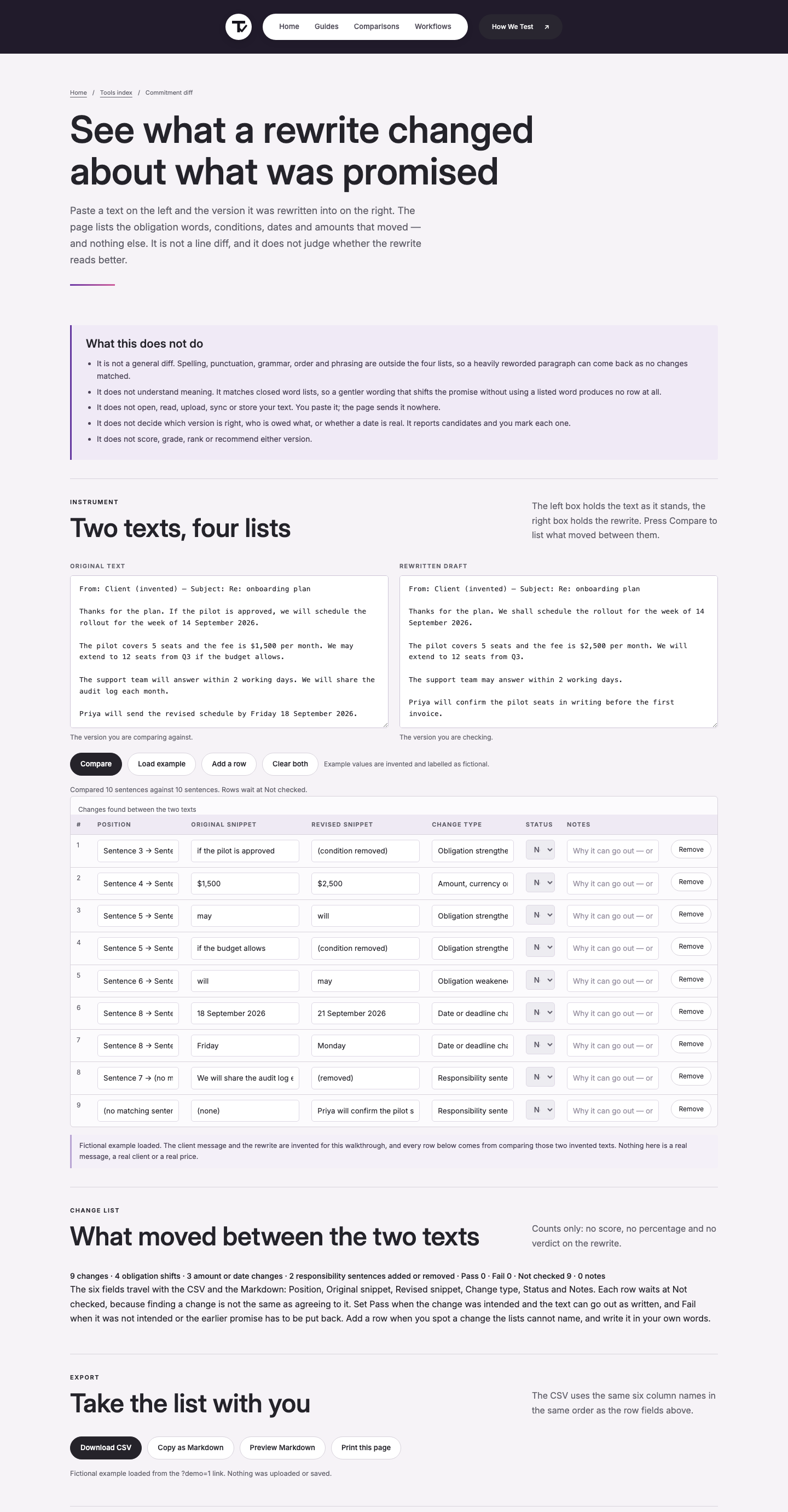
The two texts below ship with the tool as its own example, and both are invented — the page labels them as fictional on load, and no real client, price or message is involved. They are used here because the change list they produce is reproducible: open the tool, press Load example, and the same nine rows appear.
Original (invented). "Thanks for the plan. If the pilot is approved, we will schedule the rollout for the week of 14 September 2026. The pilot covers 5 seats and the fee is $1,500 per month. We may extend to 12 seats from Q3 if the budget allows. The support team will answer within 2 working days. We will share the audit log each month. Priya will send the revised schedule by Friday 18 September 2026."
Rewrite (invented). "Thanks for the plan. We shall schedule the rollout for the week of 14 September 2026. The pilot covers 5 seats and the fee is $2,500 per month. We will extend to 12 seats from Q3. The support team may answer within 2 working days. Priya will confirm the pilot seats in writing before the first invoice. Priya will send the revised schedule by Monday 21 September 2026."
The change list reports nine rows, grouped as four obligation shifts, three amount or date changes and two responsibility sentences added or removed. Sorted by what a reader would be entitled to expect, the material movements are these:
| Change | Original | Rewrite | Type | Why it matters |
|---|---|---|---|---|
| Condition dropped | "If the pilot is approved" | removed | Obligation strengthened | A conditional plan has become a flat promise |
| Obligation raised | "We may extend to 12 seats" | "We will extend to 12 seats" | Obligation strengthened | A possibility became a commitment |
| Condition dropped again | "if the budget allows" | removed | Obligation strengthened | The way out of the sentence was deleted |
| Obligation lowered | "will answer within 2 working days" | "may answer within 2 working days" | Obligation weakened | A service level became a possibility |
| Amount changed | "$1,500 per month" | "$2,500 per month" | Amount or currency | The fee moved by $1,000 a month |
| Date changed | "Friday 18 September 2026" | "Monday 21 September 2026" | Date or deadline | Both the weekday and the date moved |
| Sentence removed | "We will share the audit log each month." | absent | Responsibility removed | A recurring obligation disappeared |
| Sentence added | absent | "Priya will confirm the pilot seats in writing before the first invoice." | Responsibility added | A new step with a deadline before it |
One row of the nine is not in that table. The tool reads a weekday and a date as two separate tokens, so the move from "Friday 18 September" to "Monday 21 September" counts twice, once for the weekday and once for the date; the table above merges the pair so that the movement reads as one change. The rewrite also changes "will" to "shall" in the first sentence, which the ladder treats as the same level of commitment and reports as nothing at all — not a miss, since the two words promise the same thing. Read the list next to the two texts rather than beside the count.
The failure the tool cannot see is the one to watch for by hand. If a rewrite had turned "we will review the revised schedule" into "we will confirm the revised schedule", no obligation word moved, no date or amount changed, and the lists would report nothing — yet the reader is now entitled to a decision rather than an opinion. The tool documents this gap itself, using "review" becoming "deliver" as the illustration, and prints it on the page rather than hiding it (Commitment diff, accessed 2026-09-14; original wording: neither "review" nor "deliver" is in any of the four lists). The repair is a hand-written row with the change in the Notes field, before the message is sent.
Watch modal verbs and quantifiers
Obligation in English sits in a small number of words, and they are not interchangeable. "May", "might" and "could" describe what is possible. "Can", "should", "aim to", "plan to" and "expect to" describe what is intended. "Will", "shall", "agree to" and "commit to" describe what is promised. "Must", "required to" and "contractually" describe what is obligated. A rewrite that moves one step along that ladder changes the message more than any amount of politeness can offset, and the move is invisible when the rest of the sentence is unchanged.
Quantifiers do the same work with less visibility. "Up to 3 revisions" is not "3 revisions"; "approximately 10" is not "10"; "within 5 working days" is not "in 5 working days"; "at least" and "no more than" pull in opposite directions. A retention or storage period written as "up to" is a ceiling, and a summary that reports it as a fixed term has changed the term — the same trap appears in provider documentation, where Anthropic's privacy centre describes feedback retention as storage "for up to 5 years" (accessed 2026-09-14; original wording: "for up to 5 years").
The check is mechanical once the words are known: search both versions for the four ladder levels and for the quantifier list, and put every hit side by side. The commitment diff does this automatically for its two lists and shows the level that moved.
Check names, figures and attachments
Recipients, copy lists, reply-to addresses and attachment names are part of the message. A rewrite can leave every sentence intact and still send the right text to the wrong person, so the last pass is over the envelope rather than the body: who is in To, who is in Cc, is anyone in Bcc who was not before, and does the attachment name match the one the body refers to.
Attachments have hard limits that decide whether a promise can be kept at all. Gmail's help page states that "For personal Gmail accounts, the limit is 25 MB", that work and school accounts have the limit set by "your Google Workspace administrator", and that if the total attachment size is over the limit "Gmail automatically removes the attachment and adds it as a Google Drive link in the email" (Send attachments with your Gmail message, accessed 2026-09-14; original wording: "Gmail automatically removes the attachment and adds it as a Google Drive link in the email"). An email that promises a file "attached" has made a weaker promise than the writer intended when the file travels as a Drive link instead.
Pasting a draft into another tool creates its own limits. Claude's chat uploads accept 500MB per file and up to 20 files per chat, while project files are capped at 30MB each (Upload files to Claude, accessed 2026-09-14; original wording: "File size: 30MB per file"). Check the attachment against the smaller of the two numbers before the sentence promising it survives.
Store the original beside the sent version
Keep three things: the text as it was before the rewrite, the version that was sent, and the change list with its Pass and Fail marks. The change list is a smaller record than a screenshot of two emails, and it names each movement instead of leaving the reader to spot it.
Name the files so the pair is obvious, and keep the date the message went out with them. When a reader later asks why the schedule moved, the two texts and the change list answer the question in one place; a folder of three files called "final", "final2" and "sent" does not.
Keep both versions. The change list from the comparison is your record of what moved, and it takes less space than a screenshot of two emails.
Where a rewrite needs a person, not a tool
Some messages should not be rewritten by anyone but their owner. Anything that changes a quotation, a price, a contract term, a delivery commitment or a warranty belongs with the person who owns that commitment; a tone tool can only check that the words moved, never that the new words are permitted. The same applies to employment, disciplinary and legal correspondence, where the wording is the substance.
The escalation route is short: stop the rewrite, put the two versions in front of the owner of the promise, and let them decide which text goes out. A tool that lists what moved is exactly the input that decision needs, and it is not a substitute for the decision.
Sources checked for this guide
Each figure below was read on the page named beside it on 14 September 2026 and is quoted from there. No email client and no model was run for this guide, so no delivery, accuracy or length figure is claimed, and the two texts in the worked example are the tool's own invented sample.
- Send attachments with your Gmail message — attachment limits and over-limit behaviour (new tab) (accessed 2026-09-14; original wording: "For personal Gmail accounts, the limit is 25 MB" · "Gmail automatically removes the attachment and adds it as a Google Drive link in the email")
- Upload files to Claude — file types, size and page limits (new tab) (accessed 2026-09-14; original wording: "File size: 500MB per file" · "File size: 30MB per file")
- Is my data used for model training? — Anthropic Privacy Center (new tab) (accessed 2026-09-14; original wording: "By default, we will not use your inputs or outputs from our commercial products ... to train our models")
Not checked: the ChatGPT data-controls help article at help.openai.com returned HTTP 403 when requested on 2026-09-14, so no ChatGPT retention policy is quoted on this page.